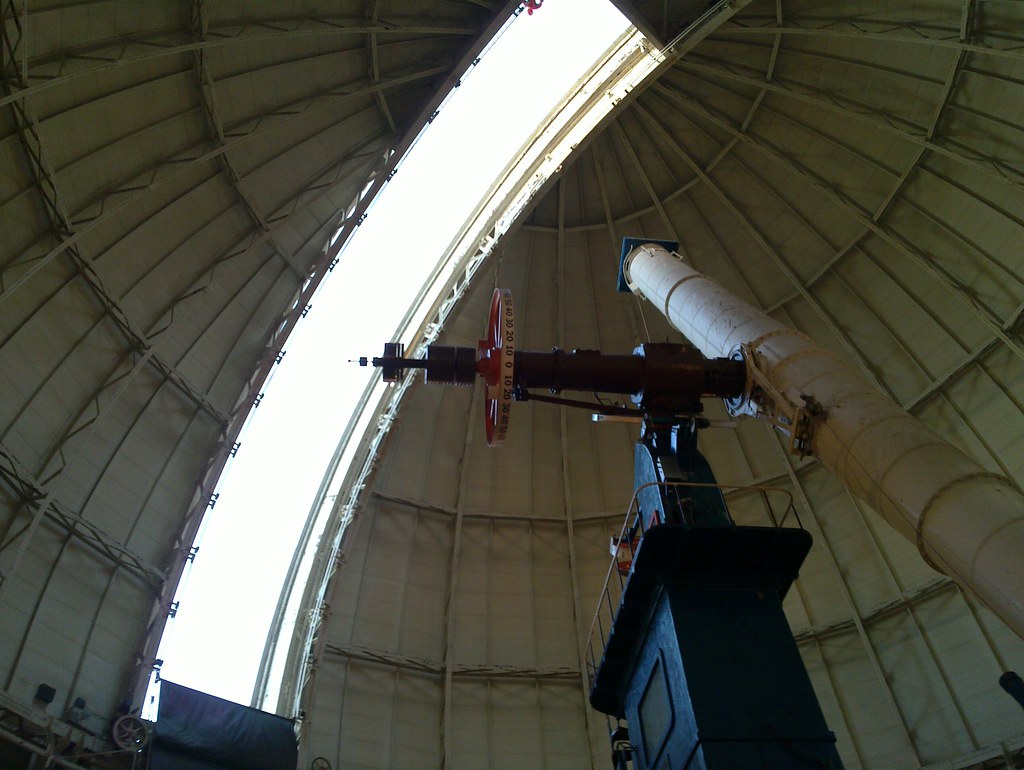
The Yerkes Observatory in Williams Bay, Wisconsin, on the north shore of Lake Geneva, was closed by the University of Chicago in October 2018. The university had operated the facility since its dedication in October 1897. The decision to close it was made in a brief announcement in March of the same year.
Two years of negotiation followed. In 2020 the Yerkes Future Foundation, a non-profit organized by Williams Bay residents and former observatory affiliates, signed an agreement with the university to take over the buildings, grounds, and all three historic telescopes.
The largest of the three is the 40-inch Clark refractor, completed in 1897 and the largest refracting telescope ever built. It is still the largest, twenty-nine years into the twenty-first century, and is likely to remain so. No serious proposal exists to build a larger one.
On the morning of May 4, 2026, Donna Charlebois, the Foundation's operations director, unlocked the main building at 8:35 a.m. and walked the long limestone corridor toward the great dome. The dome is sixty feet across. Its rotation is powered by an original electric motor installed in 1897, refurbished in 2022.
The 40-inch tube is sixty-two feet long. It rests on a steel mounting designed by Warner and Swasey of Cleveland, the firm that produced most of the world's major equatorial mounts in the late nineteenth century. The objective lens, ground by Alvan Clark and his son Alvan Graham Clark, has a focal length of approximately sixty-three feet.
Edwin Hubble used this telescope in the 1910s as a graduate student. So did Otto Struve. So did Subrahmanyan Chandrasekhar, who lived in Williams Bay during his Yerkes tenure in the 1930s and 1940s. The graduate housing he occupied is now a private residence three blocks from the observatory.
The Foundation's first task, after taking ownership, was structural. The roof of the main building leaked in eleven distinct places. The dome's drive mechanism had not been overhauled since 1968. The 40-inch's clock drive, which uses a weighted gravity system to track stars, had been stopped for nineteen years.
The roof work was completed in 2022, at a cost of $2.1 million, funded primarily by a single donation from a Chicago-area philanthropist who had attended Yerkes summer programs as a teenager in the 1970s. The dome drive was overhauled in 2023. The clock drive was restored to function in late 2024.
The clock drive's restoration was supervised by Tim Hutchison, a horological consultant from Madison, who had previously worked on the restoration of the Strasbourg Cathedral astronomical clock. The Yerkes mechanism is smaller but operates on the same principle: a falling weight, regulated by an escapement, drives the telescope at sidereal rate.
On the evening of May 4, the 40-inch was pointed at the globular cluster M3 at 9:48 p.m. The clock drive engaged. The tube tracked. A dozen visitors, members of the Foundation's friends program, took turns at the eyepiece during a two-hour observing session. The cluster was resolved nearly to its core at 350x.
Public observing nights at Yerkes are now scheduled twelve times a year. Tickets cost $90 each. The Foundation operates on a roughly $1.8 million annual budget, with revenue from public programs, individual donations, foundation grants, and a small university subsidy that is scheduled to end in 2028.
The end of the subsidy is the central question for Yerkes's next decade. Without it, the operating shortfall will be roughly $400,000 a year. The Foundation's board has set a goal of raising an endowment that produces $500,000 annually by 2028.
Whether the goal is reachable is uncertain. The Foundation's executive director, Dianna Colman, has been candid that the original donor pool — Williams Bay residents and University of Chicago alumni — is finite, and that a wider fundraising effort has produced mixed results.
What Yerkes has, that newer institutions do not, is the building and the instruments themselves. The main building, designed by Henry Ives Cobb in the Bedford limestone of late-nineteenth-century academic architecture, is a National Historic Landmark. The 40-inch is the largest refractor ever made.
The smaller instruments at Yerkes also work. A 24-inch reflector and a 41-inch reflector, both Brashear-built, are in their original domes. The 41-inch was the principal instrument for the Yerkes spectroscopic surveys of the 1960s.
Charlebois walked the upper-level catwalk that morning, inspecting a small drip stain on a ceiling panel that had appeared during the previous week's rain. The Foundation logs such observations and addresses them on a quarterly schedule. The stain was added to the list.
Williams Bay itself has changed less than one might expect. The lakeshore is still residential. The downtown is six blocks of low brick storefronts. The observatory is the village's largest single building and its principal landmark.
By 11 p.m. on the May evening, the dome was closed and the catwalk lights were off. The 40-inch's tube hung horizontal in its mount, the way it is parked for the night. The clock drive was disengaged.
Yerkes is not a working research observatory in any modern sense. It is a working historical observatory, which is a different and rarer thing, and the fact that it is working at all five years into private stewardship is, to use a word the Foundation's director avoids, modestly hopeful.