The South African Astronomical Observatory's observing station sits at 1,798 meters on a low ridge in the Karoo, fifteen kilometers outside the village of Sutherland in the Northern Cape. The site has hosted optical telescopes since 1972.
The largest instrument is the Southern African Large Telescope, the 11-meter SALT, commissioned in 2005. SALT is a fixed-elevation telescope with a segmented primary mirror, designed and operated as a partnership between South Africa and ten international member institutions, including Poland, India, and the United States.
On the morning of May 28, 2026, the site was at 4 degrees Celsius at sunrise, with a hard frost on the metal surfaces of the auxiliary buildings. By midday the temperature had risen to 17 degrees in the sun and the frost had cleared. The Karoo's late-autumn air, dry and thin, conducted heat poorly.
Theodor Pretorius, the station's senior site engineer, walked the dirt road between the main control building and the SALT dome at 7:45 a.m. He had been on the site since 6:30, finishing the previous night's observing report. The 1.9-meter Radcliffe Reflector had run a full eight-hour program. SALT had collected nine target queues totaling six and a half hours.
Sutherland's geographic isolation is its scientific advantage. The nearest large town is Cape Town, three hundred and seventy kilometers to the southwest. The light pollution at the summit, measured in the Bortle scale, is consistently Class 2. The Milky Way casts visible shadows on clear nights.
The observatory's residential accommodation, on a low rise three hundred meters from the summit telescopes, sleeps fourteen visiting astronomers. During the heart of the southern winter observing season — June through August — the accommodation runs at capacity most weeks.
Garcia visited the station in late May, the shoulder period before peak season. Three observers were in residence: a Polish postdoctoral fellow working on stellar pulsation in SX Phoenicis variables, an Indian doctoral student observing eclipsing binaries in the Magellanic Clouds, and a South African senior astronomer running calibration tests on a new SALT instrument.
The new instrument is the second-generation Robert Stobie Spectrograph, commissioned in February 2026 after a two-year development at the SALT design office in Cape Town. It replaces the original RSS, which had operated since 2009 and had developed mechanical issues with its slit-mask exchange mechanism.
The new RSS includes an upgraded volume-phase holographic grating set and a CCD detector with reduced read noise. Its first scientific use, in a paper by a University of Cape Town group submitted to Monthly Notices in April, examined the chemical composition of three carbon stars in the Sculptor dwarf galaxy.
SALT itself remains a controversial instrument in some quarters. The fixed-elevation design constrains observing geometry: a target can only be accessed when it passes through the telescope's narrow declination window. Median target accessibility is about ninety minutes per night.
The constraint is real but manageable. SALT's queue scheduler is one of the more sophisticated in operation, optimizing across hundreds of target requests to fit the night's geometry. The instrument has produced over six hundred refereed publications since first light.
Pretorius spent the morning inspecting the dome cladding on the 1.0-meter Elizabeth Telescope, a Grubb Parsons reflector commissioned at Sutherland in 1964 and still in regular use for student training and amateur consortium programs. The dome's wooden door seals had begun to deteriorate in a section visible from the south.
The Elizabeth's user base now includes a consortium of South African and Namibian universities, who fund a portion of the operating costs through a queue-based time-allocation system similar to the SMARTS arrangement at Cerro Tololo. The telescope runs roughly two hundred nights a year on consortium programs.
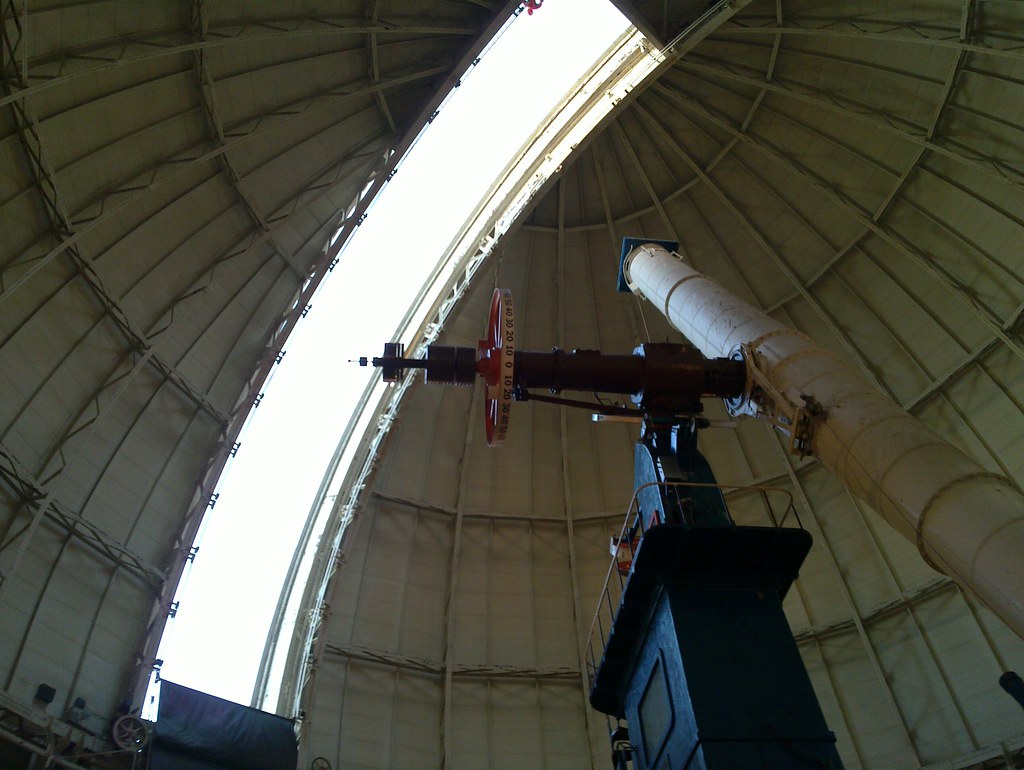
The 1.9-meter Radcliffe Reflector, originally installed at the Royal Observatory in Pretoria in 1948 and moved to Sutherland in 1974, is the workhorse of the observatory's medium-aperture research. It carries a fiber-fed echelle spectrograph called HRS, the High-Resolution Spectrograph, designed at the University of Canterbury in New Zealand and commissioned at SAAO in 2014.
HRS reaches a resolving power of 65,000 on bright stars and 16,000 in low-resolution mode. It has been used primarily for radial-velocity work on planet-hosting stars and for the characterization of pre-main-sequence binaries.
Sutherland village, fifteen kilometers down the dirt road, has a population of roughly three thousand. The village's economy is partly observatory-dependent. Several of the small guest houses cater specifically to astronomy tourists, who come for the dark skies and the proximity to the working observatory.
Public tours of the SAAO summit run twice daily during scheduled visitor periods. The tour visits the SALT viewing gallery and several of the smaller domes. It does not include nighttime observing access, which is reserved for scheduled research programs and a separately ticketed amateur-observation program at a dedicated public dome on the eastern edge of the site.
By 4 p.m. on the May day, the temperature had begun to fall again. Pretorius finished his rounds and walked back to the main control building. The previous night's three observing programs had concluded. The next night's three were preparing to begin.
Sutherland in late autumn is not yet at the cold heart of winter, when nighttime temperatures fall below minus ten and the dome heaters work continuously. It is, however, far enough into the dry season that the seeing is reliably under one arcsecond and the queues are full. The peak observing months are coming.