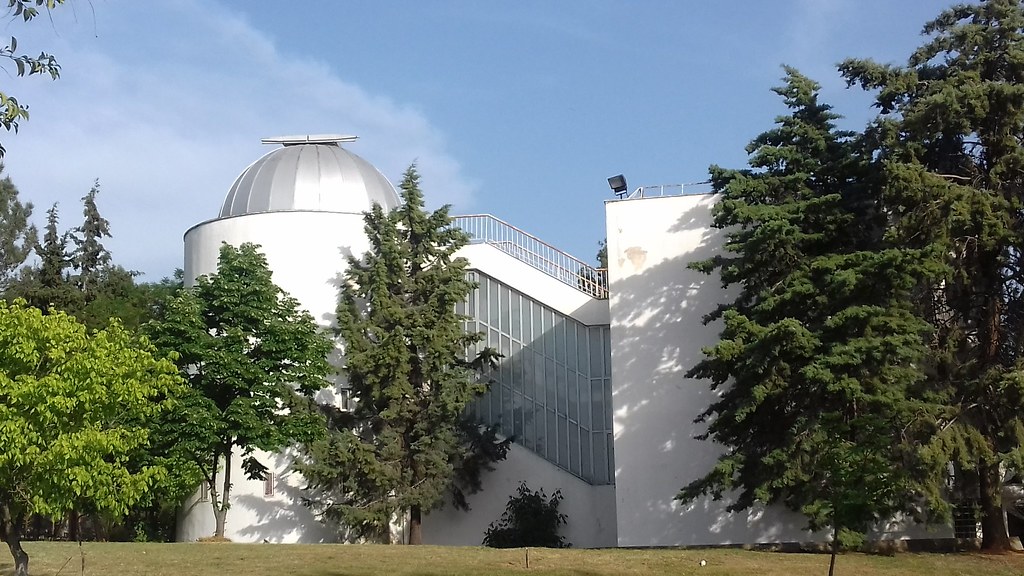
On the western edge of Carleton College's campus in Northfield, Minnesota, behind a thicket of bur oak, stands the Goodsell Observatory. It was built in 1877 from local limestone, with a copper dome over the larger of its two telescopes. The smaller dome, on the building's south wing, was added in 1965.
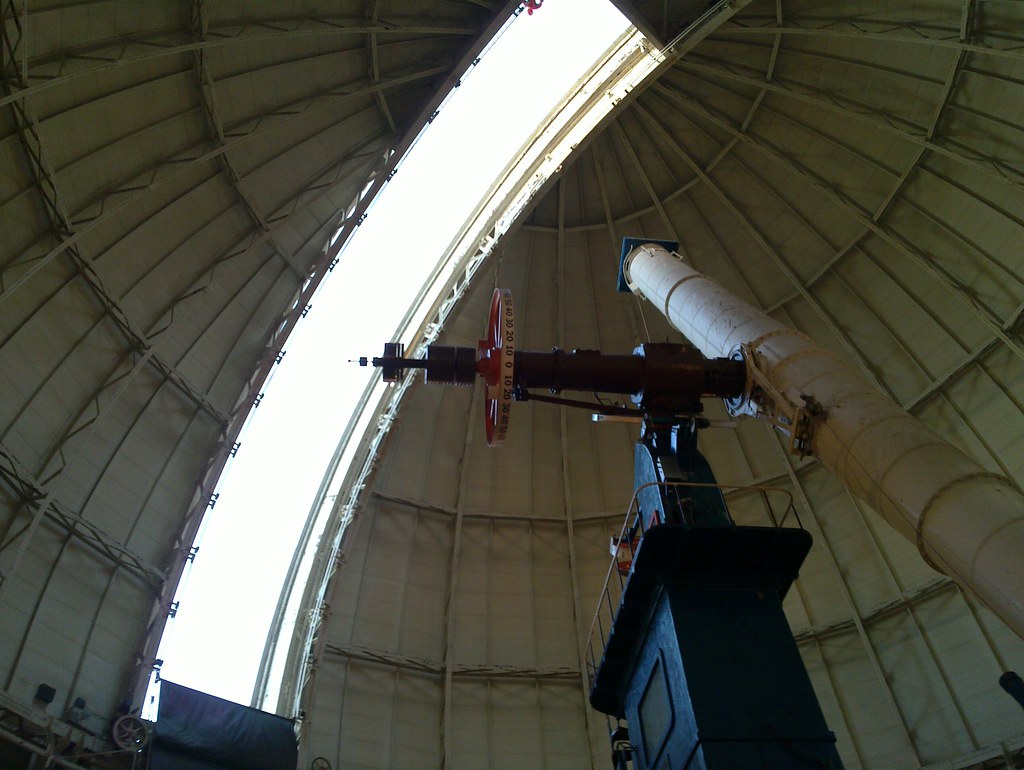
The 0.4-meter Cassegrain reflector inside the south dome turns sixty-one in 2026. It was built by Boller and Chivens of South Pasadena, California, a firm that supplied many of the smaller campus instruments installed during the post-Sputnik expansion of American physics departments.
Carleton's astronomy faculty consists of two professors and one visiting lecturer. The college enrolls about two thousand undergraduates. There is no graduate program. The 0.4-meter does not produce publishable research in any volume.
What it does is run student observing nights, every clear Wednesday and Friday during the academic year, for the three hundred or so students who take introductory or intermediate astronomy each year.
On the night of April 24, 2026, a Friday, the dome was opened at 9:14 p.m. by Joel Weisberg, the senior astronomy professor, and four students enrolled in the spring intermediate course on stellar evolution.
Weisberg has run the observatory since 1991. He keeps a small spiral notebook, kept in a desk drawer in the warm room below the dome, in which he logs each observing night: date, observer count, target list, sky conditions, anomalies. The notebook is on its fourteenth volume.
The April night's target list ran: the Beehive open cluster in Cancer, M3 in Canes Venatici, M51 the Whirlpool Galaxy, the double star Mizar and Alcor, and Jupiter, which set at 11:18 p.m.
The 0.4-meter is small by modern research standards. It is large compared to almost anything an amateur astronomer brings to a dark-site star party. At a college that is fifty miles south of Minneapolis-Saint Paul, with the corresponding light pollution, the telescope reaches down to roughly magnitude 14 with a CCD imager attached, slightly fainter with the eye at the eyepiece.
The CCD imager is a SBIG ST-8 from 2003. It still works. Weisberg has replaced the cooling fan twice and the shutter mechanism once. The control software runs on a dedicated Windows XP machine that is not connected to the internet.
The students that Friday were working on a problem set involving the apparent angular size of the Whirlpool Galaxy and the implied physical diameter at its distance of roughly twenty-three million light years. The exercise required them to image the galaxy, measure its visible extent in pixels, convert to arcminutes using the imager's known plate scale, and apply the small-angle approximation.
Two of the four students had not previously used a telescope larger than a 4-inch refractor. One had grown up using a 6-inch Dobsonian in suburban Saint Paul. The fourth had never looked through any telescope before enrolling in the introductory course.
The pedagogical point of the small-college dome, Weisberg said while waiting for the imager to download its first exposure, is not the publication-grade data. It is the embodied experience of pointing an instrument at a sky object and getting a result that the student took, with the student's own hand on the focuser.
The 0.4-meter does this. So do dozens of other small-college instruments across the United States: the 16-inch at Oberlin, the 20-inch at Vassar, the historic 12-inch refractor still mounted at the University of Pennsylvania's Flower and Cook Observatory.
Most of these instruments do not appear in any astronomical database. They do not have queue schedulers. They are not subject to senior reviews. They are operated by faculty who include observatory maintenance in their teaching load, on telescopes that were already paid for in the 1960s or earlier.
The maintenance is the variable. A failed motor on a 1965 Boller and Chivens drive cannot be ordered from the original manufacturer, which closed its astronomical division in 1989. Replacement parts are sourced from amateur telescope-maker forums, from junk piles at other observatories, or fabricated in the college's physics machine shop.
Carleton's physics machine shop, in the basement of Olin Hall across the quad, supplied a custom-machined declination clamp for the 0.4-meter in 2017. The original had cracked. The replacement, fabricated by the shop manager over three afternoons, is still in service.
By 11:45 p.m. the four students had captured ten thirty-second exposures of M51, stacked them, and were doing the angular-size measurement on a laptop in the warm room. The galaxy's two arms were visible. The companion NGC 5195 was a separate bright patch to the north.
Weisberg closed the dome at 12:20 a.m. The students walked back across the quad to their dormitories. The notebook entry for the night ran four lines, including a note that the dome rotation had stuck momentarily at azimuth 247 degrees, an issue Weisberg flagged for inspection the next afternoon.
The Goodsell Observatory is not the future of American astronomy. It is, however, where some part of the next generation of working scientists first looked at a galaxy with their own eye on a piece of glass, and decided to do it again.