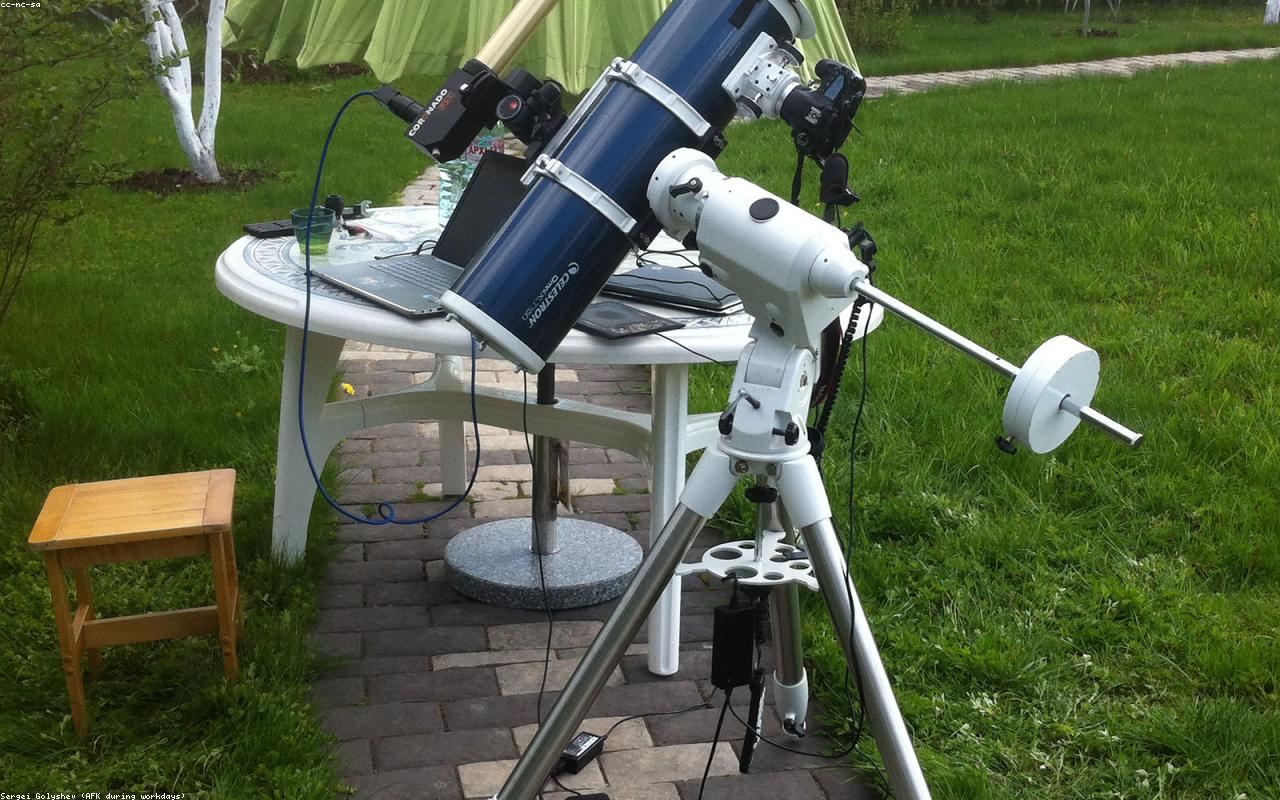
The instrument cost Iolanda Ferro one hundred and ninety euros in 2019, from a second-hand shop on the Via Toledo. It is a 60mm achromatic refractor with a focal length of 700mm, sold originally as a beginner's lunar scope. With a properly fitted Baader AstroSolar film over the objective, it has shown her every active region of consequence for the past six years.
She keeps it on a wooden tripod by the kitchen door. On clear mornings, she carries it five steps to the balcony.
There is a tradition, among amateur astronomers who own larger instruments, of treating the 60mm as a child's toy. Ferro suspects this is because most owners of large instruments have never used a small one carefully. A 60mm refractor is, in fact, the instrument with which the German amateur Wilhelm Tempel discovered six comets in the nineteenth century.
For the Sun, aperture matters less than the steadiness of the air.
On 14 May 2026, Ferro observed active region AR3947 at 10:42 local time. The seeing was rated 3 of 5 on the Antoniadi scale. Through a 12.5mm Plössl, giving 56x, she could resolve the central umbra of the leading spot, a smaller follower, and four pores trailing southwest. Her sketch took eleven minutes.
She filed the sketch with the British Astronomical Association's Solar Section the following morning, as she has every observation since January 2020.
The filter is the only part that matters absolutely. Ferro has used Baader AstroSolar Safety Film, ND 5.0, since the first month. It comes flat in an A4 sheet for around thirty euros, and she replaces the cell every two years whether it shows damage or not.
There is no safe shortcut here. Welding glass is not adequate. Smoked glass is not adequate. A Mylar emergency blanket is not adequate. A filter that screws into the eyepiece, sold with some older Japanese refractors of the 1970s, is dangerous and should be discarded the day it is found.
The film goes on the front of the objective. The eyepiece end stays cool.
Ferro built her cell from an empty oatmeal canister and electrical tape. It looks improvised because it is. The optical performance is not compromised by the housing, only by tears or pinholes in the film itself, which she checks each session by holding the cell up to a bright lamp before mounting.
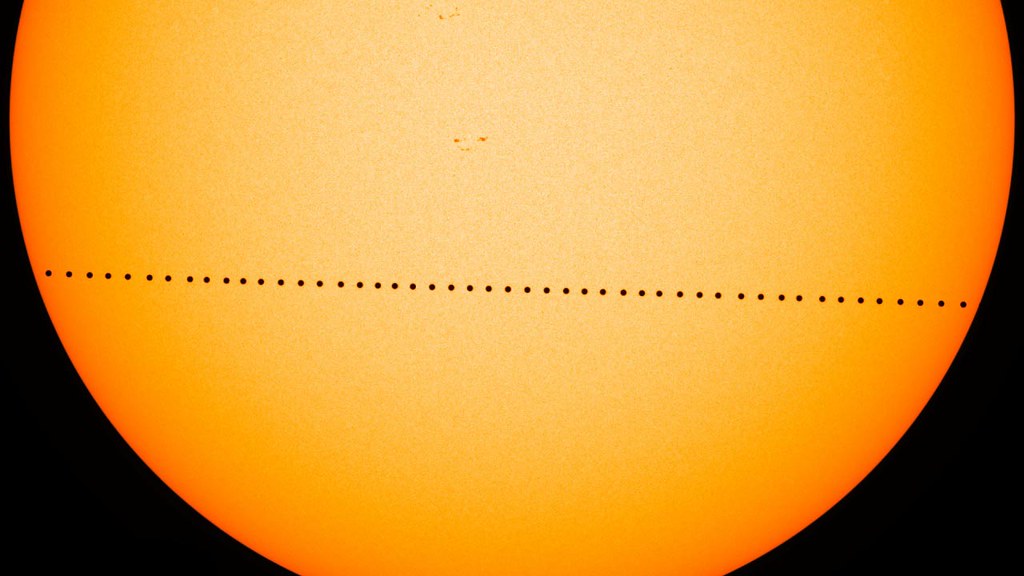
What does one see in white light? Sunspots, primarily. The granulation of the photosphere on the best mornings, like a basin of fine pebbles. Faculae near the limb in white-yellow patches. The occasional, transient brightening of a white-light flare, of which Ferro has recorded two confirmed instances since 2021.
The Sun, in white light through a small refractor, is a very specific yellow. Not white. The achromatic doublet contributes some of that warmth, and an experienced eye learns to disregard it.
The sketching kit fits in a wooden cigar box. A printed blank with a 110mm circle, a Staedtler 2B pencil, a kneaded eraser, a small ruler for the position-angle line. Ferro draws the limb first, marks north and west according to the day's geometry, then plots the spots from large to small.
She times the drift of a spot across the field to check her position angle. The Sun, at 56x, takes about two minutes to traverse a 60-arcminute field. The drift direction is celestial west.
There is a discipline in this work that the imaging amateurs do not always recognize. A drawing is a record of what an eye saw at a particular moment. A photograph is a record of what a sensor accumulated over many moments. Both have value. The drawing is the older form, and it remains useful for tracking how an observer's perception develops.
Ferro keeps her sketches in three-ring binders organized by Carrington rotation. She has fourteen binders.
The 60mm refractor will not show the chromosphere. For that, a hydrogen-alpha filter is required, and the cost rises by an order of magnitude. Ferro owns a Coronado PST as well, which she uses on perhaps one morning in five. Most days, she returns to the small refractor.
The reason is practical. The white-light view of a sunspot group includes a level of fine detail that hydrogen-alpha tends to obscure with the surrounding chromospheric structure. For sunspot counting, for following the development of an active region over days, white light remains the standard.
It is also faster to set up. Hydrogen-alpha needs an etalon temperature to stabilize. White light needs nothing.
Ferro recommends the 60mm refractor to anyone who asks where to start. The full kit, including filter material and a serviceable eyepiece, can be assembled for under three hundred euros. The skills it teaches transfer to any larger instrument that might follow.
There is one caveat she always adds. Solar observing has no second chances. The eye gives no warning before damage occurs and recovers only partially or not at all. The film goes on first. The film comes off last. Children near the instrument are watched, every second.
She has been observing the Sun, on and off, for nineteen years. The small refractor still surprises her on the best mornings, when a sunspot's penumbra resolves into the radial filaments that Galileo first described in 1610, drawn with a quill in the manuscript of his Istoria e Dimostrazioni.
The quill and the pencil are not so different an instrument, finally.