The Specola Solare Ticinese sits on a hillside above Locarno in the Italian-speaking canton of southern Switzerland. It is an unremarkable building, a low concrete pavilion with a copper-coloured dome, owned now by the Università della Svizzera Italiana and operated in cooperation with the World Data Center for the Sunspot Index in Brussels.
On most clear mornings since 1957, an observer has stood inside the dome and drawn the Sun.
Iolanda Ferro visited the Specola Solare on 9 April 2026 at the invitation of Marco Cagnotti, the long-serving observer who succeeded the founder, Sergio Cortesi, in 2015. Cortesi observed at Locarno for fifty-eight years. Cagnotti has now logged eleven. Between them they account for roughly ninety percent of the station's observational record.
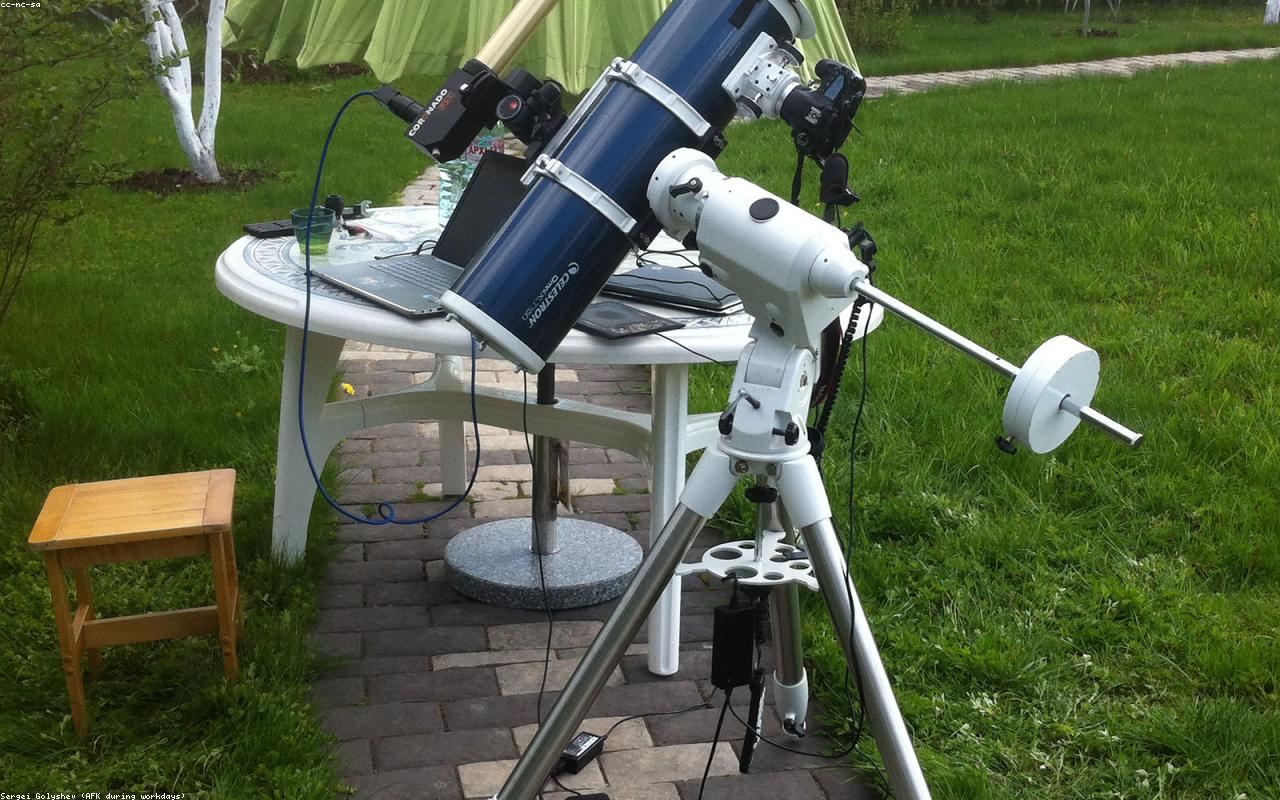
The instrument is a Zeiss refractor of 150mm aperture, dating from the late 1950s, mounted on the original equatorial of the same period. The image of the Sun is projected by Galilean projection onto a 26cm white disc on a wooden easel.
The drawing is made with a soft pencil directly onto a paper template printed each morning. It takes between fifteen and forty-five minutes, depending on solar activity.
There is nothing else. No camera, no spectroheliograph, no automated detection. The drawing is the record.
Cagnotti explained the procedure to Ferro in the small office adjacent to the dome. The observer first orients the projected disc using the diurnal drift of a chosen sunspot, then draws the limb, then marks the sunspots from largest to smallest. Penumbrae are shaded with light cross-hatching. Umbrae are filled solid.
Smaller features, pores below a certain size threshold, are recorded as single dots. The judgment of what counts as a pore and what does not is the part of the work that takes years to develop.
Cortesi spent his first decade, he once told an interviewer, learning to see the Sun reliably. Cagnotti agrees that the first year of full-time solar observing produces, in retrospect, drawings the observer is embarrassed by.
What the Locarno record provides, that no satellite-era observation can replicate, is continuity. The station's drawings extend back to 1957 and overlap with the records of the Zürich Federal Observatory, which extend back to 1849, and through those to the original work of Heinrich Schwabe in Dessau between 1826 and 1843.
The chain of human observers, with its inconsistencies and its slow methodological drift, is now the basis on which the modern International Sunspot Number is calibrated.
The number is not what most amateurs assume. It is not a count of sunspots. It is a weighted index, defined by Rudolf Wolf in 1849, that combines the number of individual spots with the number of identifiable spot groups, multiplied by a personal coefficient assigned to each observer to account for their tendency to see more or fewer spots than the long-term reference.
Cagnotti's coefficient is currently 0.61, calibrated against the network's other observers. Cortesi's was 0.60. The closeness of the two is not coincidence. Cagnotti was Cortesi's student.
Ferro asked, gently, whether the work might be done now by automated software analysing satellite images.
Cagnotti's answer was long and considered. The short form was that it could be, but it would be a different measurement.
Automated detection of sunspots from satellite imagery is well developed and produces excellent daily counts. What it does not produce is a record continuous with the historical archive. The human-eye count, with all its limitations, is the measurement on which two centuries of solar-cycle research is built, and breaking the chain in favour of a more accurate but discontinuous record would lose the long view.
There is also, Cagnotti added, the matter of having a person at the eyepiece every clear morning who knows what the Sun looked like the previous morning. This is a kind of monitoring that an automated system performs differently.
The dome at Locarno is opened at 8:30 each morning the weather permits. The drawing is usually complete by 10:00. Cagnotti scans it, files the original, and emails the day's count to the World Data Center in Brussels by noon.
The Specola Solare has, on average, two hundred and ten clear mornings per year. The records of cloud-day non-observation are themselves a documented part of the dataset.
Ferro left Locarno in the early afternoon. The dome was closed. Cagnotti was at his desk, comparing the morning's drawing against the previous week's, looking for changes in the development of two active regions.
Solar observing at this level of consistency is a small profession. There are perhaps eight stations worldwide that contribute regularly to the international sunspot index using direct visual observation, and the number has been declining slowly across the past two decades.
Cagnotti is fifty-four years old. He has not yet identified the next observer in the line.
The drawings, the binders, the daily index sheets, the Zeiss refractor with its original 1958 brass tube clamps, all of these will outlast the present observer. Whether the practice will outlast him is, for the moment, an open question.
Ferro suspects it will. There is a stubbornness to the work that survives the convenience of newer methods, and the long record at Locarno is now a kind of inheritance that someone, somewhere, will want to continue.
Filed under