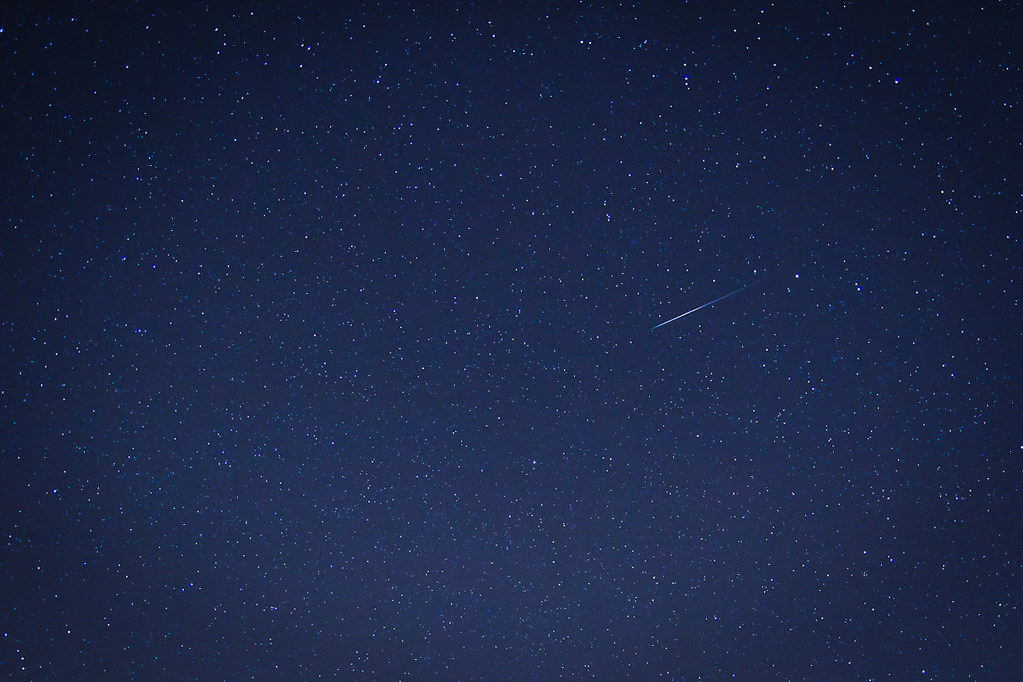
On the night of 12 August 2025, Iolanda Ferro counted seventy-three Perseids from a folding chair in the olive grove behind her house in Volla, eight kilometres east of Naples. She had set an alarm for 1:40 a.m., walked outside in slippers, and counted in ten-minute intervals on a small clipboard.
Her notebook from that night opens with one line. Sky clear, slight haze south, moon set 23:11. The rest is tally marks, time stamps, and the occasional comment about a long train.
The Perseids are the most reliable shower of the northern summer, and almost everything about them rewards modest preparation. The shower peaks in the second week of August, typically between the 11th and 13th. In 2026 the maximum falls on the night of 12-13 August, with a waning crescent moon that sets before midnight in most of Europe and the eastern United States.
Ferro's preparation begins three days before the peak. She watches the moon's phase, the local forecast, and the seven-day cloud trend from the Aeronautica Militare. She does not commit to a site until forty-eight hours out.
The shower's radiant, in the constellation Perseus, rises in the northeast after about 10 p.m. local time at mid-northern latitudes. Rates climb steadily after midnight and peak in the small hours before dawn, when Perseus stands high.
The advice that Ferro gives her readers is the advice she gives her own neighbours, who knock on her door each year asking what time to come outside. She tells them to come out at midnight, and to stay out for at least an hour.
Ten minutes of observation does not give the shower a fair hearing. The eye needs twenty to thirty minutes to dark-adapt, and the apparent rate fluctuates so much that a short session can produce three meteors or twenty by the luck of the clock.
She recommends, in order of importance, a reclining chair, a warm blanket, and a planisphere or printed star chart. A red-filtered headlamp is useful but not essential. A telescope is, for meteor observation, actively unhelpful.
The reclining chair matters because the human neck is not built for two hours of upward stare. A zero-gravity garden chair, the kind sold for twenty-five euro at any hardware shop, makes the difference between a pleasant night and a sore morning.
The blanket matters because August nights at altitude or near the sea can be cooler than the daytime forecast suggests. Ferro keeps a wool blanket folded by the door from late July onward.
Site selection is the part most amateurs overcomplicate. A truly dark site improves the count, but a moderately dark suburban garden with an unobstructed northeastern horizon will still yield a satisfying session.
The single most useful action a home observer can take is to put the brightest local light source — a porch lamp, a street fixture, a neighbour's security floodlight — behind a wall or a hedge.
Counting is optional but rewarding. Ferro records meteors in ten-minute bins, noting brightness on a rough five-point scale and direction of travel. She submits her totals to the International Meteor Organization within a week.
The IMO's online form takes about four minutes to complete and contributes to a global zenithal hourly rate calculation that has been refined for more than half a century. The amateur who counts is the amateur who matters to the science.
Children, in Ferro's experience, last about forty minutes. She suggests starting them at 11:30 p.m., when Perseus is low and the rates are modest, so that a single bright meteor in the first half-hour feels like a gift.
She also recommends, for first-time family observers, the Quadrantid mythology of making a wish. It is harmless, it focuses the watcher, and it produces, in her observation, more careful seeing than any technical instruction.
What ruins a Perseid night, more often than weather, is expectation. The advertised peak rate of a hundred per hour assumes a perfect sky overhead, a high radiant, and a trained observer.
A suburban observer at 1 a.m. in mid-August, on a clear night, with the moon down, should expect forty to sixty meteors in a two-hour session. That is a generous gift from the debris stream of comet 109P/Swift-Tuttle, last at perihelion in 1992 and not expected back until 2126.
Ferro closes her August piece in the magazine each year with the same small admission. She has never seen a Perseid fireball brighter than Venus. She has watched the shower for thirty-one consecutive years.
She offers this not as discouragement but as calibration. The point of the Perseids, she writes, is not the rare bright meteor. The point is the rhythm — the dark sky, the count, the slow movement of Perseus across the August sky, and the morning's coffee on the porch after.