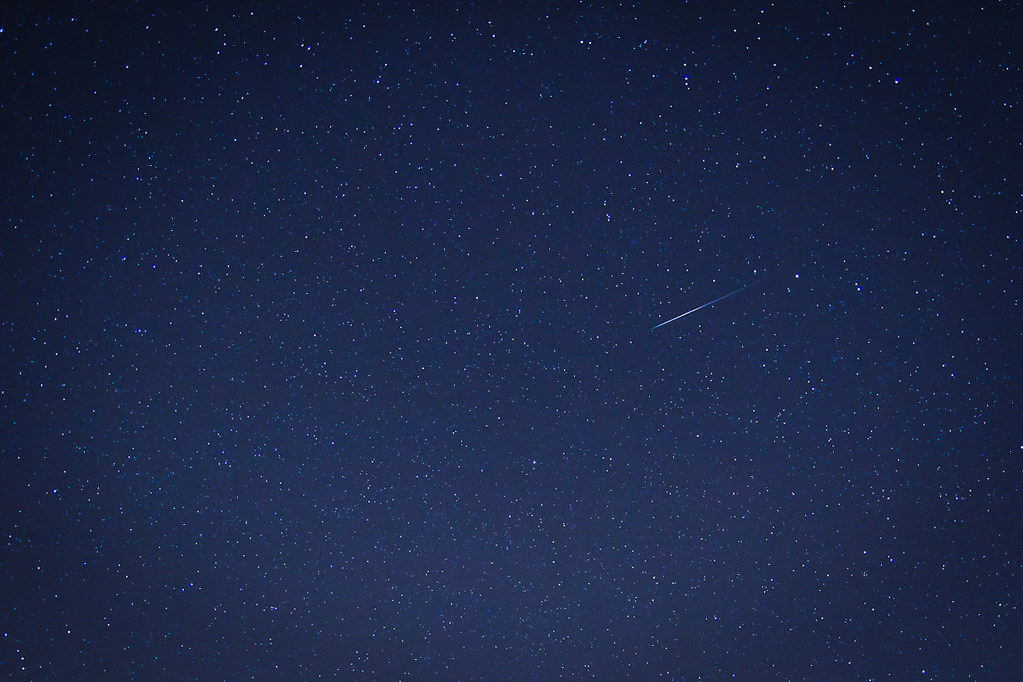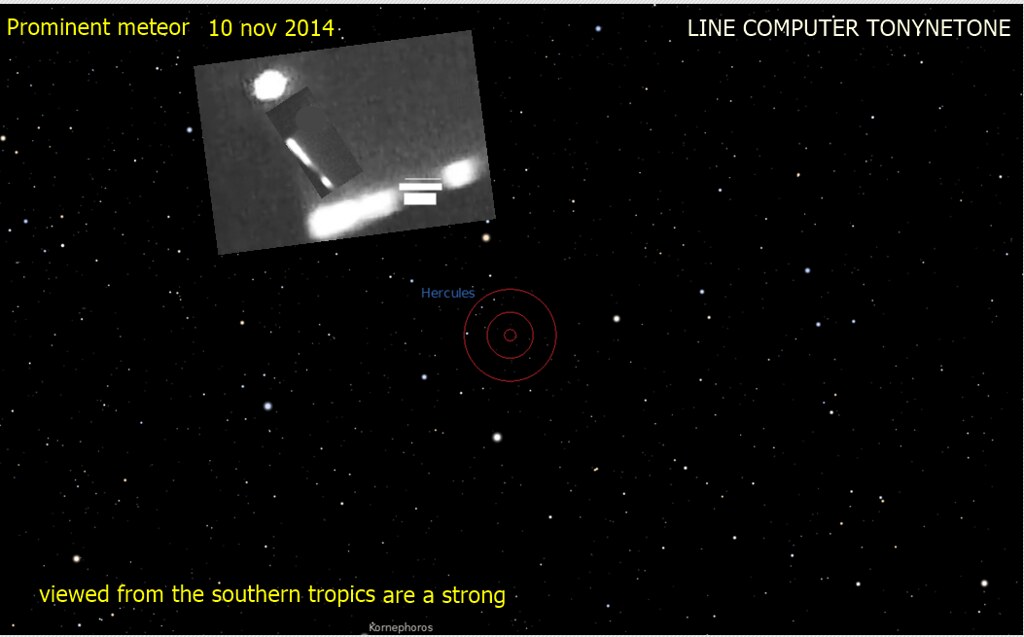
On the night of 12-13 November 1833, observers across the eastern United States looked up to find the sky filled with falling stars. Contemporary estimates placed the rate at between one hundred thousand and two hundred thousand meteors per hour at the peak.
The Leonid storm of 1833 was the founding event of modern meteor astronomy. It convinced the discipline that meteors were astronomical, not meteorological, phenomena, and it inaugurated a century of systematic shower study.
Cosmo Tate's annual November column on the Leonids is, in part, an exercise in memory. The amateur observer who watches the modern Leonids must reckon with the fact that the shower's historical reputation rests on events almost none of his readers will see.
The Leonids are debris from comet 55P/Tempel-Tuttle, which orbits the sun on a thirty-three-year cycle. The debris stream is heavily concentrated near the comet itself, and the most spectacular Leonid storms occur in the years immediately following the comet's perihelion passage.
The 1833 storm followed a Tempel-Tuttle perihelion in 1832. The 1866 storm followed a perihelion in 1865. The 1966 storm — the most recent, and one of the most spectacular, with rates above forty thousand per hour over the American Southwest — followed a perihelion in 1965.
The comet's most recent perihelion was in 1998. The Leonid storms of 1999, 2001, and 2002 produced impressive but more modest peaks, with rates between one thousand and three thousand per hour observed from various parts of the world.
The next perihelion is in 2031. The amateur observer is, until then, watching a shower whose annual peak rates run between ten and twenty meteors per hour, with occasional small enhancements when the Earth crosses denser strands of the older debris.
Tate is careful, in his column, not to oversell this. The 2026 Leonids, peaking on the night of 17-18 November, are likely to produce rates near the lower end of that range, modestly diminished by a gibbous moon that will not set until well after the radiant has risen.
What the modern Leonids offer is not spectacle but velocity. Leonid meteors enter the atmosphere at seventy-one kilometres per second, which is among the highest of any annual shower. The result is a meteor that is short, fast, and frequently leaves a persistent train.
Persistent trains, in Tate's experience, are the Leonids' great gift to the patient observer. A bright Leonid can leave a glowing trail visible for thirty seconds to a minute, twisting and fading in the upper atmosphere as high-altitude winds disturb the ionised gas.
Tate keeps in his office at Harvard a facsimile of an Adolphe Quetelet engraving of the 1833 storm. The engraving shows men, women, and children kneeling in the snow on a Brooklyn street while meteors fall through the sky in numbers that the engraver clearly could not draw.
The image is not literally accurate — no meteor shower has ever produced light bright enough to make the city itself visible as the engraver shows — but it captures a documentary truth about how the event was experienced.
Eyewitness accounts of the 1833 storm describe people running into the streets, churches throwing open their doors for prayer, and ships at sea being woken by the night-watch. The Cherokee historical record dates the start of one tribal era from the storm.
The 1866 storm, smaller but well observed, was the event that allowed Hubert Newton at Yale and Giovanni Schiaparelli at Brera to independently calculate the orbit of the Leonid stream and identify Tempel-Tuttle as its parent — the first time a meteor shower's parent body was correctly identified.
The identification was the discipline's other founding event. After 1866, meteor astronomy was, for the first time, a question of orbital mechanics rather than meteorology.
The 1966 storm, observed from Kitt Peak, the McDonald Observatory, and dozens of amateur sites across the American Southwest, lasted only about forty minutes at peak but reached rates that some observers compared to a snowfall.
Tate has spoken to three of the surviving observers — all amateurs at the time, all now in their eighties. Each remembers the experience in similar terms. The sky moved.
The 2031 Leonid return is the next opportunity for storm-level rates, and Tate notes, without making predictions, that orbital modelling suggests the years 2032 and 2033 may produce enhancements approaching the 1999-2002 levels.
Until then, the Leonids are a modest shower with a great history. Tate's recommendation for the 2026 observer is to step outside for an hour after midnight on 17 November, count whatever comes, and remember that the same dust stream that produced the storms of 1833 is still, in its quieter way, producing meteors over the back garden.
The continuity is the point. The amateur who counts ten Leonids in an hour in 2026 is part of an unbroken chain of observation that begins with the men and women who knelt in the streets of Brooklyn in November 1833.