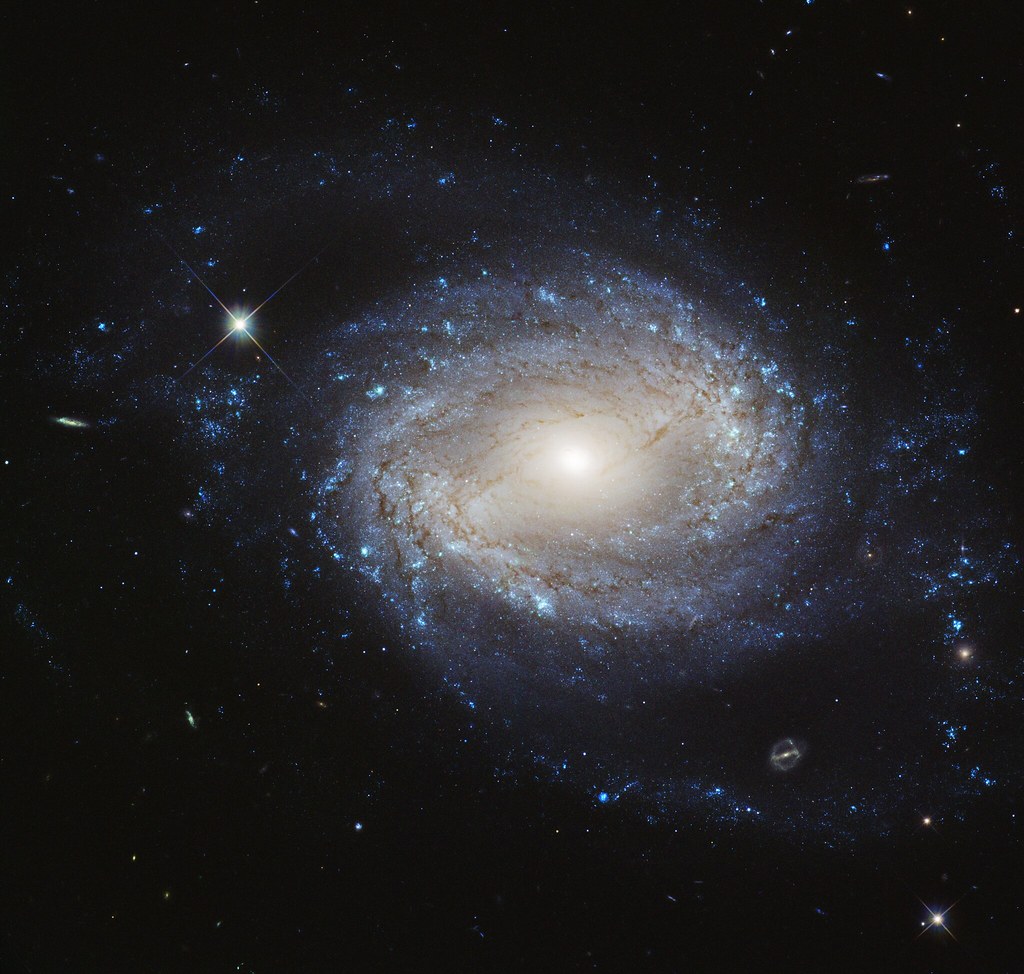
On a clear, cold night in October 1970, at the prime focus of the 84-inch telescope at Kitt Peak National Observatory in southern Arizona, Vera Rubin and Kent Ford spent six hours photographing the spectrum of the Andromeda galaxy through an image-tube spectrograph that Ford had built, by hand, in a basement laboratory at the Carnegie Institution in Washington.
The plates they exposed that night, and on dozens of nights like it through the following decade, would force into general view a problem in extragalactic astronomy that had been quietly avoided since the 1930s.
Spiral galaxies were not rotating the way they were supposed to.
Rubin was forty-two years old in October 1970. She had taken her doctorate at Georgetown in 1954, under George Gamow, with a thesis on the large-scale distribution of galaxies that the field had received politely and ignored. She had spent the following sixteen years raising four children, teaching part-time at Montgomery College in Maryland, and observing whenever Carnegie could spare her time at one of its telescopes.
In 1965 she had become the first woman to be granted observing time at the Palomar 200-inch under her own name. The previous rule, an unwritten one, had excluded women from the dormitory at the summit. The dormitory was renovated to add a single women's bathroom. The rule was quietly retired.
The instrument that made the rotation work possible was the Carnegie image tube. Ford had begun developing it in the late 1950s in collaboration with the Department of Terrestrial Magnetism. The tube amplified the light of a galaxy's spectrum by a factor of about twenty, which meant that a spectrum that would previously have required an all-night exposure on the 200-inch could be obtained, in passable form, in two or three hours at a smaller telescope.
This was the technical opening that mattered. Rubin and Ford did not need the largest telescopes. They needed access to medium-aperture instruments often enough to build up a sample.
They began with Andromeda, M31, the nearest large spiral. They measured the Doppler shift of the H-alpha emission line at intervals along the galaxy's major axis. From the shifts they extracted a rotation curve: the orbital velocity of the gas as a function of distance from the galactic centre.
The expected behaviour, given the visible distribution of stars, was a Keplerian falloff. Beyond the bright inner bulge, where most of the mass was assumed to lie, orbital velocities should decline with the inverse square root of the radius. The rotation curve should peak and then drop.
It did not drop. It went flat. At the outer edge of the visible disk, at a radius of about thirty kiloparsecs, the rotation velocity was essentially the same as it had been at twelve.
Rubin and Ford published the M31 result, jointly, in 1970, in The Astrophysical Journal. The paper is cautious. They note the flatness. They do not draw the inference that would later be drawn from it. They suggest, in their concluding paragraph, that further observations of other galaxies would be desirable.
Over the next decade they observed about sixty more spirals. The result repeated. The rotation curves were flat. They were flat for small galaxies and for large ones, for tightly wound spirals and for loose ones, for galaxies in clusters and for isolated ones in the field.
By 1978, when they published a major synthesis in The Astrophysical Journal Letters, the pattern was unambiguous. Spiral galaxies contained, somewhere, a great deal of mass that did not emit detectable light.
The inference was not new. The Swiss-American astronomer Fritz Zwicky had proposed, in 1933, that the Coma cluster of galaxies contained a vast amount of dunkle Materie based on the velocities of its member galaxies. The proposal had been ignored for forty years on the grounds that Zwicky was difficult, that his estimates were uncertain, and that the cluster might simply be unbound.
What Rubin and Ford added, in a way that was harder to dismiss, was a clean, repeatable measurement in a regime where the alternatives were few. A single galaxy's rotation curve could perhaps be explained by a peculiar mass distribution. Sixty of them could not.
Rubin herself was careful, throughout her career, never to claim that she had discovered dark matter. She would say, in interviews, that she had measured rotation curves and that the theorists could decide what they meant.
She was also careful to credit Kent Ford. The image tube was the enabling technology. She would say, more than once, that without Ford's instrument the work would have been done by someone else, somewhere else, perhaps a decade later.
The cultural context of the rotation work has sometimes been compressed into a story about a woman who had been kept out and who broke through. The compression is not wrong, but it is partial. Rubin had been kept out, of certain dormitories and certain meetings, in ways that are documented in the correspondence files at the Carnegie archives.
She had also, by 1970, found a working arrangement that suited her, at an institution that did not demand a daily commute, with a collaborator who built the instruments she needed and did not compete with her for authorship.
The arrangement permitted a particular kind of patient work. The rotation programme ran for fifteen years before the synthesis paper. It depended on observing runs of three to five nights at a time, scheduled around the children's school holidays, with Ford driving the equipment out from Washington in a wood-panelled station wagon.
The wagon survived until about 1981. It is occasionally mentioned in the Carnegie observing logs.
Rubin received the National Medal of Science in 1993. She did not receive the Nobel Prize, an omission that has been remarked on with increasing frequency since her death in 2016. The Vera C. Rubin Observatory in Chile, formerly the Large Synoptic Survey Telescope, was renamed in her honour in 2019. It saw first light in 2025.
The observatory will produce, over its ten-year survey, a catalogue of about twenty billion galaxies. Many of them will have measurable rotation curves. The expectation, drawn from forty-five years of follow-up work, is that the curves will continue to be flat, and that the nature of the matter responsible will continue to be unknown.
Rubin would have liked, one suspects, both halves of that sentence.