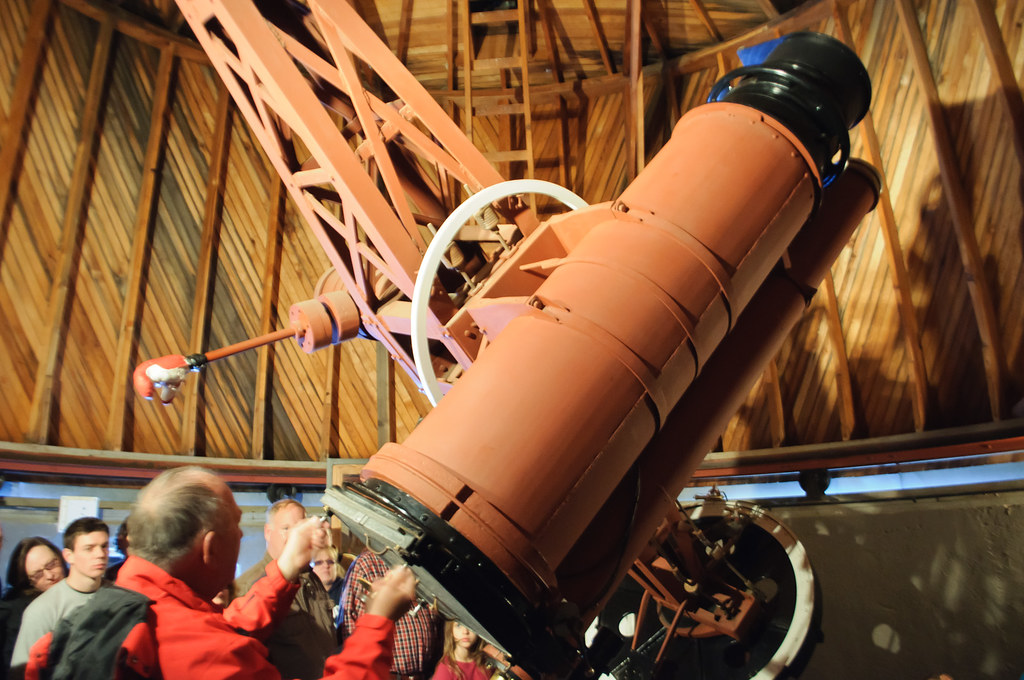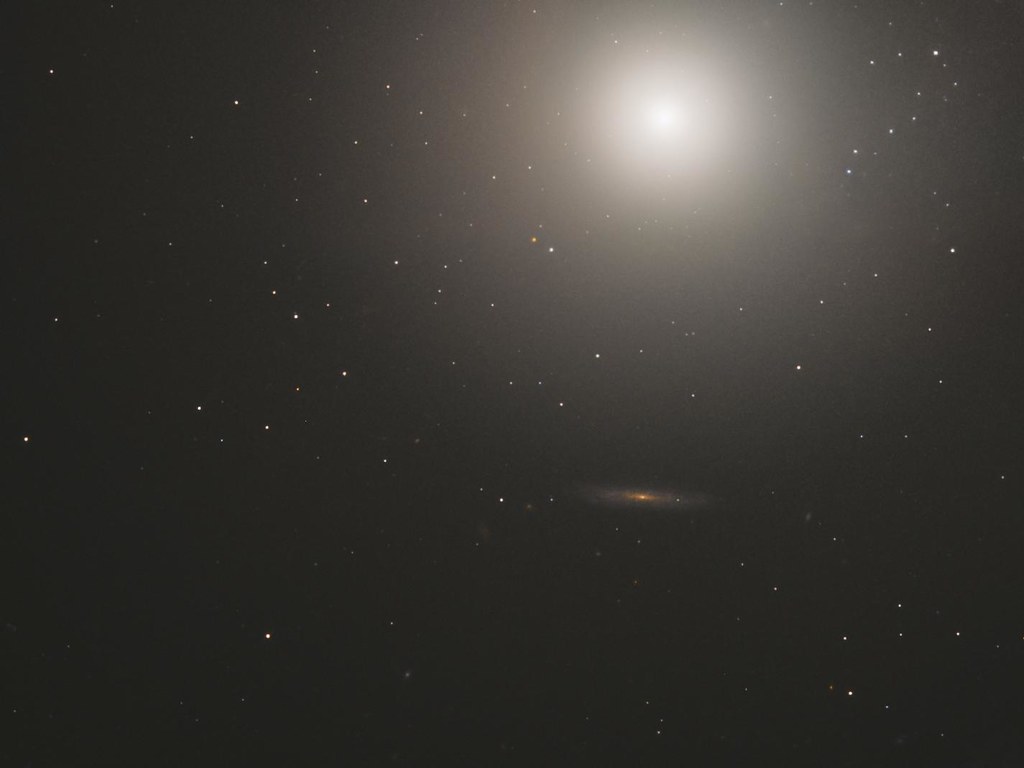
On the night of March 14, 2026, in a field outside Trumansburg, New York, a retired earth-science teacher named Donald Verrill aimed an eight-inch Newtonian at a smudge of light in Coma Berenices and crossed M64 off a list he had been working through since November of 2023.
It was the eighty-ninth object. He had twenty-one to go.
Verrill, who is seventy-two, began his Messier program the way most people do, which is to say in fits and starts. He had owned the telescope since 1998. He had also owned a copy of Stephen O'Meara's Deep-Sky Companions: The Messier Objects since 2002, and had read it twice without ever observing more than a dozen of the entries it described.
What changed, he says, was the pandemic and then his retirement, and then a small green notebook his wife gave him for Christmas in 2023.
The notebook is a Leuchtturm1917, lined, with a thin ribbon marker. He uses one page per object. The page is dated, the time is recorded in UTC, the seeing is rated on the Antoniadi scale, and the eyepiece is noted. He sketches with a 2H pencil and a soft kneaded eraser. Most sketches take him twenty minutes.
Charles Messier was a French comet hunter who, beginning in 1758, kept a list of fuzzy non-cometary objects so that he could stop wasting his nights on them. The first version of the list was published in 1774 and contained forty-five entries. By 1781 it ran to a hundred and three, and posthumous additions from his notes brought it to a hundred and ten.
Messier himself almost certainly never observed every object that now bears his number. M102, in particular, is a long-standing puzzle that astronomers still argue about. Verrill plans to observe both candidate galaxies and decide for himself.
He works from a property he and his wife bought in 2017, a five-acre field with a single mercury-vapour streetlight a quarter mile down the road. The light is shielded by a hedgerow of red cedar that he has been letting grow for eight years. The Bortle rating, by his own measurement, is between 4 and 5.
Most Messier observers in North America try to complete the catalogue in a single night, during the March-to-April window when the Marathon is possible. Verrill considered this and dismissed it. He wanted, he says, to look at each one.
His first entry was M42, the Orion Nebula, observed on the evening of November 11, 2023, from his back porch. He used a 25 mm Plossl in a 1.25-inch focuser and noted that the Trapezium showed four stars without difficulty. He spent forty minutes on the sketch.
By the end of that winter he had reached M48. By the end of 2024 he had observed sixty-one entries. He took the summer of 2025 off, mostly, except for the globular clusters in Sagittarius and Scorpius that pass low across his southern horizon between June and August.
Some entries are humbling. M74 in Pisces, a face-on spiral, is reputedly the faintest object in the catalogue and has earned a small reputation as the Marathon-killer. Verrill observed it on October 19, 2025, after three failed attempts in the preceding fortnight. His sketch shows a circular smudge with no detail. The note beside it reads simply, "Visible. Barely."
Others arrive easily. M31, the Andromeda Galaxy, took eight minutes including the walk to the telescope. M45, the Pleiades, took as long as he wanted to give it, which on that particular night in December 2024 was just over an hour.
Verrill keeps a separate column for what he calls second sittings. These are objects he returned to, sometimes years after the first observation, to check his notes against a second look. So far he has done this with twenty-two entries. In nineteen cases he was satisfied with his original sketch. In three he added detail.
He estimates that the project will be finished in late 2026. He plans to spend a full week in northern Pennsylvania, near Cherry Springs, working through the remaining southern entries with a darker sky than his own.
What he will do after that, he is unsure. He has read O'Meara's Hidden Treasures, which catalogues a hundred and nine non-Messier objects of comparable interest. He has also looked into the Herschel 400, a list of the brightest objects in William Herschel's general catalogue, which would take him an estimated four years.
When asked whether he keeps the notebooks for posterity, he laughs. He has no children. The Cornell Lab of Ornithology, where he volunteers, has a small natural-history library that would accept them. So would the local astronomy club.
He thinks he will probably just keep them on a shelf in his study, beside the O'Meara book and the eyepiece case.
There is, in Verrill's project, an answer to the standard complaint that the Messier catalogue is no longer useful. It is true that modern catalogues are larger, better, more complete. It is also true that no modern catalogue has yet produced an eight-by-five-inch Leuchtturm with a sketch of M51 drawn at the eyepiece on a Tuesday in February.
Messier's hundred and ten was never a scientific document, even in his own time. It was a working list, made for one reason and used for another, and what survives of it is the discipline of a man who looked at the sky carefully enough to be annoyed by what he saw.
Verrill is annoyed by very little. He likes that the catalogue has an end. He likes that the end is in sight. He has, on his desk, a small calendar in which he has crossed off no days at all, only nights.