The Gaia spacecraft was launched from Kourou, French Guiana, on December 19, 2013, into a Lissajous orbit around the second Lagrangian point of the Sun-Earth system. It carried two telescopes, a one-billion-pixel focal plane, and a mission plan to measure the position, motion, and brightness of every star brighter than twenty-first magnitude.
The mission's third major data release, designated DR3, became public at noon CEST on June 13, 2022. It catalogued one billion eight hundred and eleven million sources. It also included, for one hundred and eighty-three million of them, full radial velocities, spectroscopic parameters, and astrophysical classifications.
Four years on, the DR3 catalogue is the working substrate of a substantial fraction of stellar astronomy. A short audit, conducted in May 2026 across three working observatories, gives some sense of where it has actually mattered.
At the Astrophysics Department of the University of Padua, a graduate student named Lucia Marenzio is using DR3 to identify field stars contaminating a study of the Pleiades cluster. Without DR3 parallaxes, she says, the work would take her a month. With DR3 it takes an afternoon.
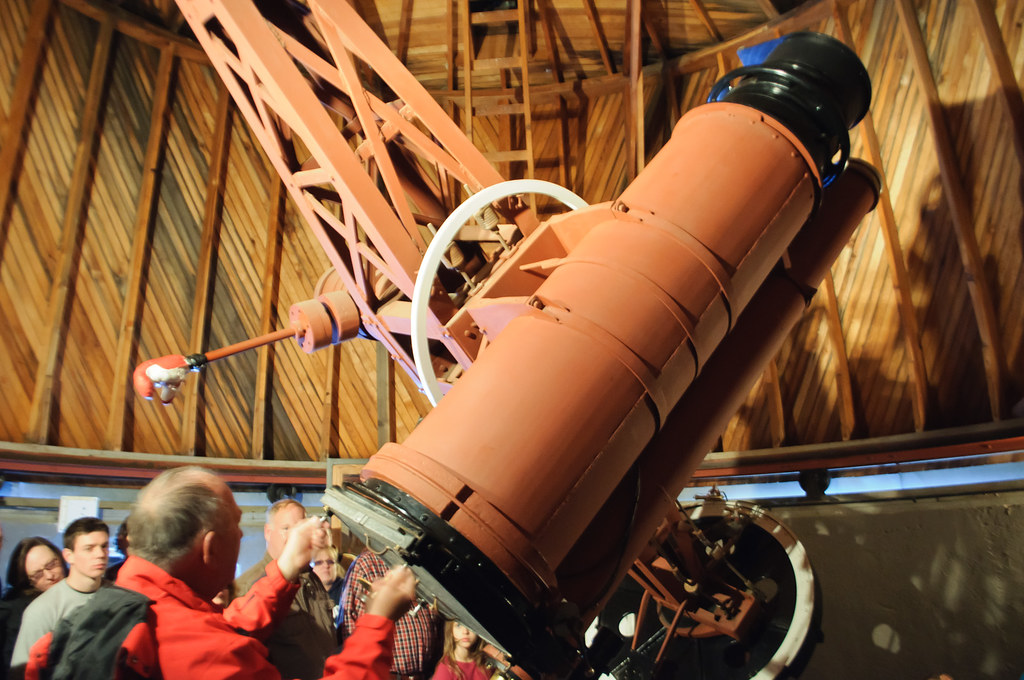
At Lick Observatory on Mount Hamilton in California, the small-telescope program uses DR3 positions to align the historical plate archive with modern fields. About four hundred and ten thousand plates have been digitised since 2017. The astrometric solution, which until 2022 used the UCAC4 catalogue, now uses Gaia. Position errors have dropped from a typical fifty milliarcseconds to under five.
At Cerro Tololo Inter-American Observatory in the foothills of the Chilean Andes, the SMARTS consortium uses DR3 to plan follow-up observations of transients flagged by the Vera C. Rubin Observatory's commissioning data. The cross-match between Rubin's source list and DR3 is now standard.
These three uses, in three observatories on three continents, hint at a pattern. Gaia DR3 is not so much a discovery catalogue as a foundation catalogue. It does not, by itself, find new things. It allows other instruments to find things more accurately.
For the amateur, the effect is subtler but real. Star atlases published before 2022, including the much-loved Sky Atlas 2000.0 by Wil Tirion, are now superseded for purposes of position by the Gaia-based atlases produced from 2023 onwards. The differences are typically in the second decimal of an arcminute, which is invisible at the eyepiece but matters to anyone using a goto mount.
Stellarium, the open-source planetarium software, integrated Gaia DR3 into its 1.3 release in October 2022. Users with the full star catalogue installed can now display sources down to magnitude twenty-one, with positions accurate to the spacecraft's measurement.
The mission has also produced what may be the most consequential addition to the working knowledge of the Milky Way since the Hipparcos catalogue of 1997: a three-dimensional map of stars within roughly a kiloparsec of the Sun, accurate enough to identify the major substructures of the local disc.
DR3 includes, for the first time, full astrophysical parameters for one hundred and seventy million stars: effective temperature, surface gravity, metallicity, extinction. For a subset of about thirty million it includes radial velocities good to one or two kilometres per second.
It also includes a catalogue of eight hundred and thirteen thousand binary star systems with orbital solutions, an inventory of one hundred and fifty-six thousand minor solar-system bodies with astrometry, and a list of about ten million galaxies and quasars classified from low-resolution spectra.
The classification of the quasars is not perfect. The Gaia team estimates a contamination rate of roughly two percent for the brightest sources, rising to five percent at the faint end. A small literature exists on cleaning the sample. The work is ongoing.
The mission itself is winding down. On January 15, 2025, the spacecraft consumed the last of its cold-gas micropropellant, and on January 27 the ground crew at the European Space Astronomy Centre in Madrid began the process of safing the instrument. The final science observation was recorded on January 15.
Two further data releases remain. DR4, expected in 2026, will cover the full five-and-a-half-year nominal mission and is anticipated to include catalogues of variable stars, exoplanet candidates, and an improved binary list. The final release, DR5, will incorporate the full eleven-year extended mission data and is expected no earlier than 2030.
The European Space Agency estimates that the full Gaia archive will continue to produce refereed publications at a rate of roughly two thousand per year for the next two decades. The mission has, by some accounting, already become the most-cited single space mission in the history of astronomy.
For amateurs, the practical changes have been quieter. The Stellarium star catalogue is larger and more accurate. The free planetarium software KStars integrated DR3 in version 3.6.6, released in November 2022. The popular planning software SkySafari has used DR3-derived positions since version 7.2.
A small piece of folklore has begun to circulate among amateur observers, partly true and partly aspirational, which holds that anyone with a telescope and a half-decent goto mount can now resolve binary stars Gaia has measured that nobody else has ever published. This is technically possible for a handful of systems. In practice it requires patience, dark skies, and a willingness to spend three weeks measuring something nobody else needs measured.
Which is, of course, what amateurs have always done. The Gaia catalogue does not change the relationship between the amateur and the sky. It changes what the amateur can know about what they are looking at.
It is the kind of catalogue Dreyer would have understood. It is enormous and precise and not yet finished. It rests on the assumption that other people, in some future decade, will need to look something up. And so the Astronomical Data Centre in Strasbourg, where the archive is held, has set up its servers to expect them.