On a winter morning in 1911, in a small upstairs room of the Harvard College Observatory on Concord Avenue, Annie Jump Cannon sat down at a wooden desk under a north-facing window, switched on a small electric lamp, and began to classify the spectra of southern-hemisphere stars at a rate she would maintain, roughly, for the next thirteen years.
She worked from glass photographic plates, each about eight by ten inches, each carrying the smeared spectral signatures of hundreds of stars exposed at the observatory's southern station at Arequipa, Peru. She read the plates with a small loupe. She called out a spectral class. A junior assistant wrote it down.
Her cataloguing rate, well-documented in the observatory's daily logs, reached about three stars per minute at her steadiest. Over the course of her working life she classified somewhere between three hundred and fifty thousand and four hundred thousand stellar spectra. No one before or since has done this work on that scale by hand.
The classification system she used was, by then, mostly her own.
When Cannon arrived at the observatory as a paid assistant in 1896, the spectral-classification scheme inherited from Edward Pickering and Williamina Fleming had run through most of the alphabet. The classes were lettered A through Q, ordered by the strength of the hydrogen Balmer lines.
Cannon, working through the southern plates, found that the scheme did not survive contact with a larger and more varied sample. Some classes collapsed into others. Some had no astronomical reality at all. She rearranged the surviving letters into the temperature sequence that is now taught to first-year astronomy students: O, B, A, F, G, K, M.
She did not announce this as a revolution. She announced it as a tidying-up. The 1901 paper in which the sequence first appears is titled, with characteristic modesty, Spectra of Bright Southern Stars.
The deeper insight, that the sequence was ordered by surface temperature rather than by composition or evolution, would not be made firm until the work of Cecilia Payne-Gaposchkin in 1925. Cannon herself remained agnostic about the underlying physics. Her job, as she conceived it, was to read the plates as accurately and as quickly as possible.
The product of those thirteen years of plate-reading was the Henry Draper Catalogue, published in nine volumes by the Harvard College Observatory between 1918 and 1924. The catalogue lists spectral classes for 225,300 stars. A later extension, completed in 1949 after Cannon's death, brought the total to about 359,000.
The catalogue is named for Henry Draper, the New York physician and amateur astronomer who had pioneered stellar spectroscopy in the 1870s and who had died young in 1882. His widow, Anna Mary Palmer Draper, funded the Harvard work as a memorial.
Cannon's name does not appear in the title. It does appear, in small type, on the title page of each volume, listed as the compiler. The convention of the period.
Cannon had been deaf since a childhood attack of scarlet fever in the late 1860s. She spoke in the careful, slightly toneless cadence of someone who had learned to lip-read in adulthood. Her colleagues at the observatory, several of whom also had hearing loss from various causes, communicated with her through a mixture of notes, exaggerated mouthing, and a sign vocabulary developed in-house.
She did not regard her deafness as an obstacle. She did regard the fact that she could not vote as an obstacle, and she marched in suffrage parades in Boston in 1915 and 1919.
Her workspace at the observatory has been preserved. The desk is small. The chair is upright. There is a wooden box beside the desk for plate storage and a green-shaded lamp clamped to the desk edge. The room receives, by design, no direct sunlight. The plates were and are vulnerable to heat.
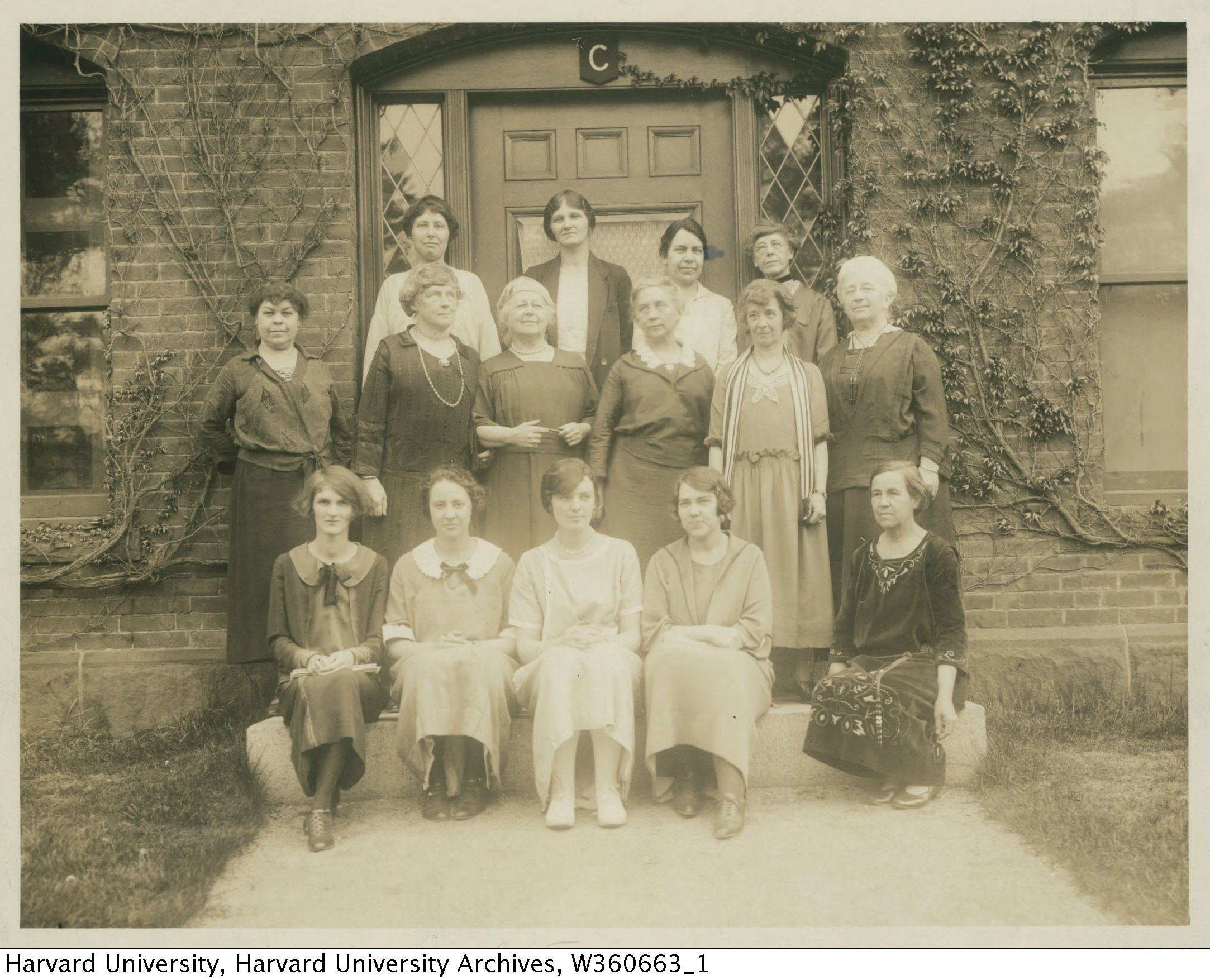
Cannon shared this room, for most of her career, with a half-dozen other women who had been hired, beginning in the 1880s, to do the photometric and spectroscopic computing that the male staff astronomers regarded as drudgery. The group was sometimes called the Harvard Computers and sometimes, less kindly, the Pickering harem.
The women were paid about twenty-five to thirty cents an hour. Male staff astronomers, doing comparable work, were paid roughly twice that. The disparity was openly acknowledged in observatory correspondence of the period. It was not, in the institutional view, a problem.
Cannon was promoted to Curator of Astronomical Photographs in 1911 and held the post until her retirement in 1940. She was the first woman to receive an honorary doctorate from Oxford, in 1925. She was awarded the Henry Draper Medal of the National Academy of Sciences in 1931.
The medal citation runs to a single paragraph and avoids the word woman entirely. The omission was, by then, the new etiquette.
She did not write much about her own working method. The most extended account is a short piece she contributed to the observatory's annual report for 1922, in which she describes the process of reading a plate as a kind of close attention that, once trained, becomes almost involuntary. The eye, she said, learns to see a class the way it learns to see a face.
She compares it, in passing, to her childhood habit of reading the night sky from the porch of the family house in Dover, Delaware, with her mother. Her mother had taught her the constellations from a small star-atlas by candlelight. The atlas, she notes, was the same one her father had used as a boy.
The continuity is the point. Cannon's sequence is still taught. The mnemonic devices that students use to remember it have changed, several times, with changes in classroom etiquette. The letters themselves remain.
When the Sloan Digital Sky Survey began publishing automated spectral classifications in 2000, the pipeline was tuned to reproduce, as a baseline, the Cannon sequence. The decision was made not out of nostalgia but because, on inspection, the sequence was found to be a clean parameterisation of the underlying physics.
Cannon died on 13 April 1941, of heart disease, at the home in Cambridge she had shared with her sister. She was seventy-seven. She had been retired from active classification work for less than a year.
Her papers are held by the Harvard University Archives. The notebooks are written in pencil, in a small clear hand, on ruled paper. They contain almost no commentary. The stars are listed by Harvard plate number, by spectral class, and, where she felt it worth recording, by a single word in the margin. The most frequent word is good.