On 31 October 1988, the Spanish parliament passed Law 31/1988, formally titled the Law on the Protection of the Astronomical Quality of the Observatories of the Canary Islands. It was the first national-level sky-protection law in the world. The law is colloquially, and with some affection, called the Ley del Cielo.
The law covers the islands of La Palma and Tenerife and the airspace above them. It regulates outdoor lighting, controls the wavelengths of advertising signs, restricts aircraft overflights of the two main observatories, and addresses radioelectric interference and atmospheric pollution.
The two observatories the law protects are the Observatorio del Roque de los Muchachos on La Palma and the Observatorio del Teide on Tenerife. Both are operated by the Instituto de Astrofísica de Canarias, the IAC, headquartered in La Laguna.
Roque de los Muchachos sits at 2,396 metres on the northwestern rim of the Caldera de Taburiente, the great volcanic depression that dominates La Palma's geography. The site hosts eighteen telescopes, including the 10.4-metre Gran Telescopio Canarias, currently the largest single-aperture optical telescope in the world.
Last Light visited the observatory on 12 May 2026, hosted by Federica Bianco, who works on outreach at the IAC. The visit began at the visitor centre at El Roque at 17:00 and continued, with formal access to the site, until 22:00.
The drive up from Santa Cruz de La Palma, the island's capital, takes about ninety minutes by the longer LP-4 route. The road climbs through a series of vegetation zones — laurel forest, then Canary pine, then a high zone of broom and rock — that record the island's vertical climate gradient.
Above 1,500 metres the air becomes notably drier. The inversion layer, which sits at around 1,200 metres for most of the year, traps moisture below it. The summit is in clear air on more than 70 percent of nights.
The Ley del Cielo's lighting provisions are administered by an office of the IAC called OTPC, the Technical Office for the Protection of the Quality of the Sky. The office has technical staff who measure compliance, mediate disputes, and certify fixtures for use within the protected zone.
The certification list is detailed. Streetlamp fixtures, advertising signs, sports lighting installations, and even illuminated billboards are reviewed and either approved or rejected. The OTPC publishes its decisions on its website. The list as of June 2026 ran to 4,260 approved fixture models.
Compliance with the lighting provisions is, by Bianco's account, uneven. Most of the island's eighty municipalities take the law seriously. A few, particularly in the more developed tourist areas of the southern coast, have been slower to retrofit.
The overall trend, however, is favourable. Satellite data from the VIIRS day-night-band sensor show that La Palma is, almost uniquely in the European territories tracked, getting darker. The mean radiance over the island has decreased by approximately fifteen percent between 2014 and 2024.
By comparison, the mean radiance over Tenerife has increased by eight percent in the same period. Tenerife, the larger and more populous of the two islands, has had a harder time with implementation, particularly in the south, where tourism development has been intense.
The visit to the summit included a tour of the Gran Telescopio Canarias dome, which is open to organised visits during the daytime. The dome is 33.5 metres in diameter and rotates on a circular rail at the rate of 26 minutes per revolution. The mirror, at 10.4 metres, is composed of 36 hexagonal segments.
The telescope was not in operation during the daytime visit, but Bianco described its typical observing schedule. It is scheduled essentially every clear night and is operated remotely from the IAC's control room in La Laguna on Tenerife.
The visiting writer left the summit at 22:00, in compliance with the standard visitor curfew. Observation from outside the controlled area was permitted, and the drive down to the public viewpoint at the Llanos del Jable, at 1,360 metres, took thirty minutes.
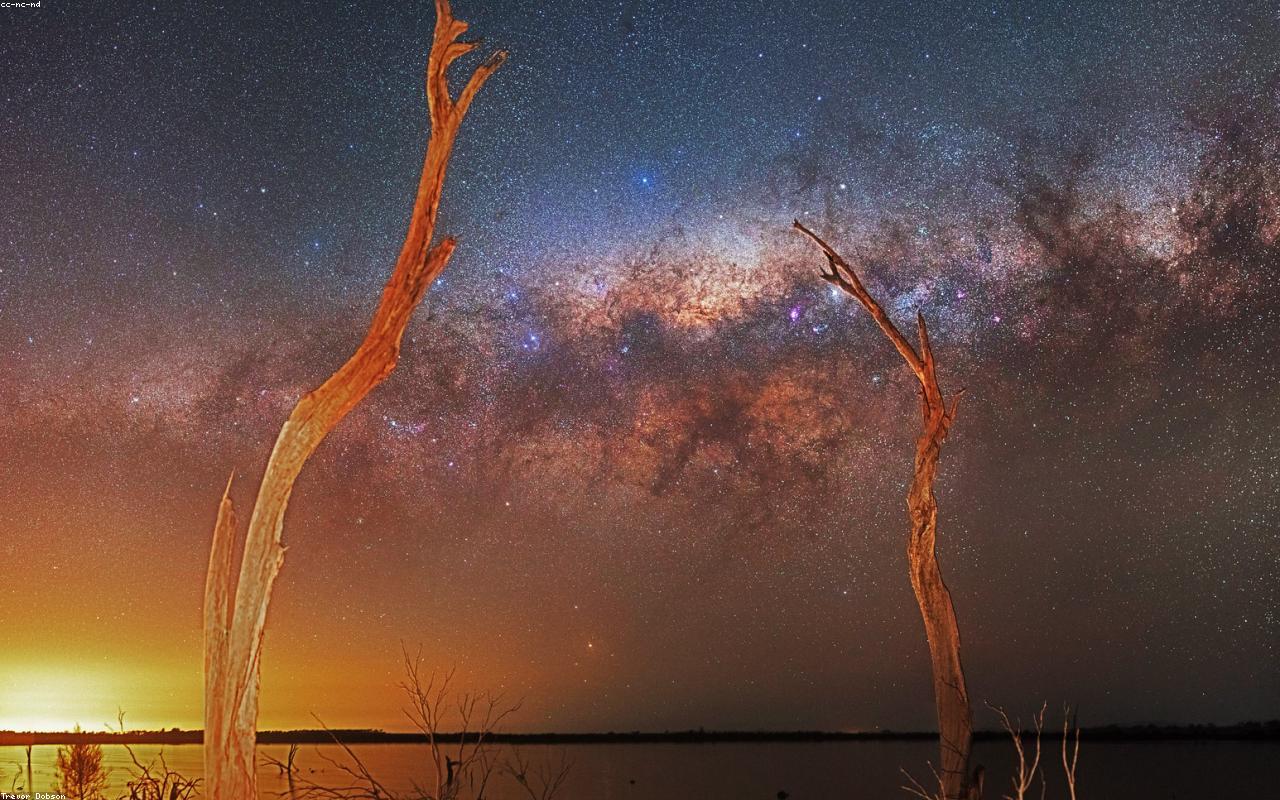
At Llanos del Jable an SQM reading taken at 23:00 produced a value of 21.78 magnitudes per square arcsecond. This is darker than essentially any site of comparable latitude in continental Europe. The Milky Way passed nearly through the zenith.
The southern sky from La Palma's latitude of 28.7 degrees north includes constellations that mainland European observers see only marginally. Centaurus rises high in the southwest in May. Omega Centauri, the largest globular cluster visible from earth, is well placed.
Through 10x50 binoculars from the Llanos viewpoint, Omega Centauri at midnight was an obvious naked-eye object, an unmistakable round patch among the southern stars. The fainter southern globular cluster, NGC 5139's neighbour M83, was also faintly visible.
The Ley del Cielo is approaching its fortieth year. There is, Bianco said, ongoing discussion within the IAC and the regional government of the Canary Islands about updating the law to address newer pressures, particularly LED lighting in colour temperatures the original law could not have anticipated, and the rapidly growing population of low-orbit satellites that are visibly degrading sky quality from even the best protected sites.
Updating a forty-year-old law is hard. The original Ley del Cielo passed because the IAC argued, persuasively, that the Canary Islands had a unique scientific asset worth protecting. The same argument, Bianco said, will need to be made again. The science is, if anything, more important now than it was in 1988.