On a wet Tuesday afternoon in May 2026, Anselm Bauer sat at his kitchen table in Munich with four small metal tubes, an 8-inch Newtonian propped on the table beside him, and a notebook in which he intended to settle, once and for all in his own mind, the question of which collimation tool was the best.
He did not settle the question. The conclusion he arrived at, after a season of comparison, was that the question itself was wrong.
Collimation is the alignment of the optical elements of a telescope so that the optical axis passes cleanly through the centre of the primary mirror, the centre of the secondary mirror, the centre of the focuser drawtube, and the centre of the eyepiece. In a Newtonian reflector, the mirrors will go out of alignment with use, with transport, and sometimes with nothing more than the slow seasonal expansion and contraction of the tube.
A well-collimated Newtonian shows tight stars, clean diffraction patterns, and resolves detail to the theoretical limit of its aperture. A poorly collimated Newtonian shows soft stars, comatic streaks at the centre of the field, and an image that no amount of focusing can fully sharpen.
The four tools Bauer tested were a 1.25-inch Cheshire eyepiece by Sky-Watcher at twenty-eight euros, a Hotech SCA laser collimator at one hundred and forty, a Howie Glatter 2-inch laser with a Blug at four hundred and twenty, and a star-test workflow using nothing more than an out-of-focus image of a bright star at high power.
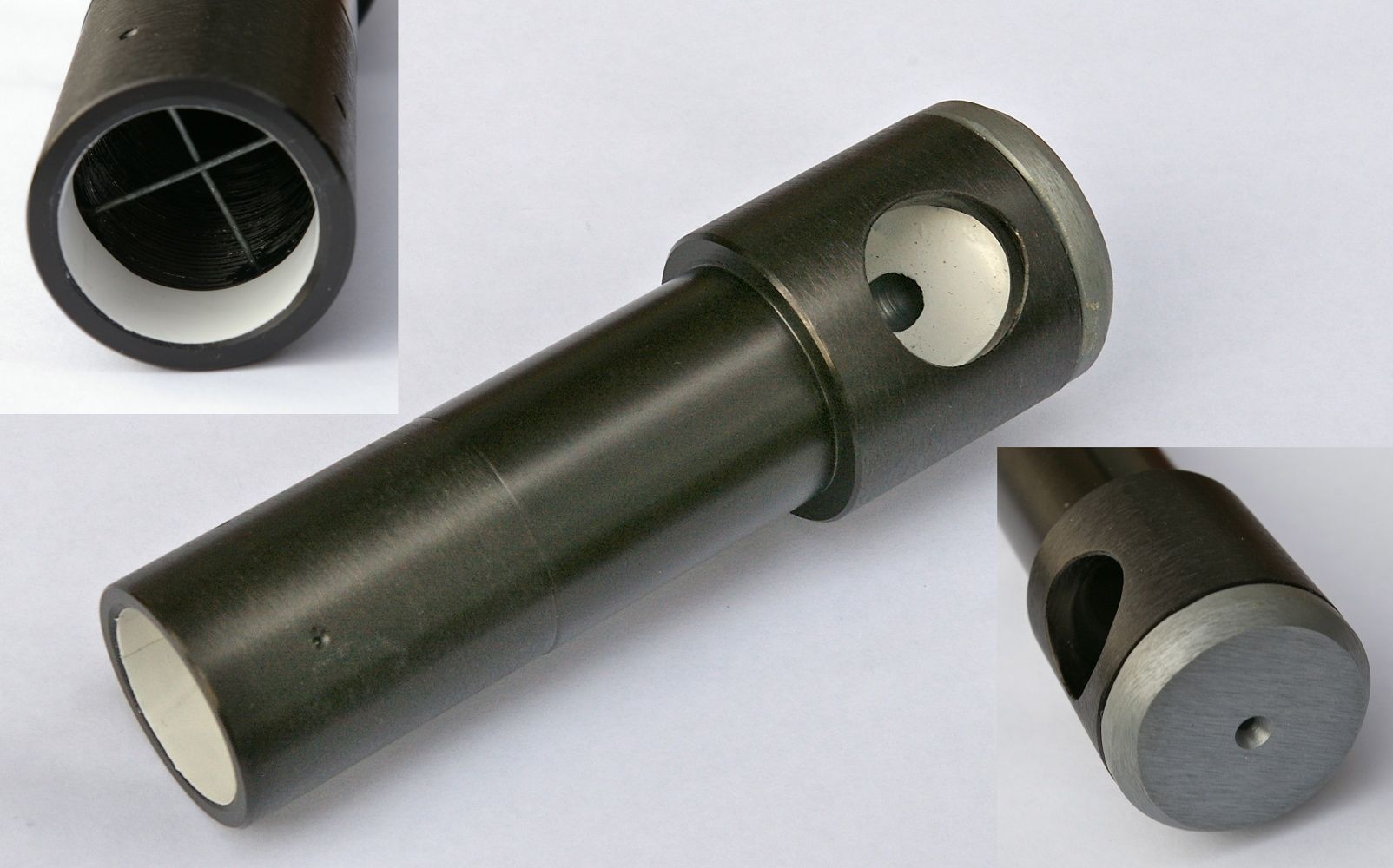
The Cheshire eyepiece is the oldest of the four tools by design. It is a metal cylinder with a small peephole at one end, a 45-degree polished surface inside, and a side window that admits light to illuminate the polished surface. Looking through the peephole shows the reflection of the eyepiece's own polished surface in the secondary mirror, in the primary mirror, and back. A correctly collimated telescope shows a concentric series of circles ending in the central spot of the primary mirror.
The Cheshire is unglamorous. It takes longer to use than a laser. It cannot, by itself, set the squareness of the focuser. It is, in Bauer's view after a season of use, also the most trustworthy collimation tool he owns.
The reason is that the Cheshire shows the actual optical path. The observer is looking, through the peephole, along the same line that light will take when it converges on the eyepiece during observation. There is no battery to die, no laser to drift out of its own alignment, no electronics to fail. A Cheshire that arrives correctly machined will remain correctly machined indefinitely.
The Hotech SCA laser collimator is more convenient. The observer drops the unit into the focuser, switches it on, and adjusts the secondary and primary mirrors until the projected laser beam returns into a small target on the unit's body. The procedure takes, with practice, less than five minutes.
The weakness of the laser collimator, well documented in the amateur literature but worth repeating, is that the laser itself must be in collimation with the body of the unit. A laser that exits the unit even a fraction of a degree off-axis will lead the observer to collimate the telescope to that offset rather than to the true optical axis. Bauer checked the Hotech against a V-block on his kitchen counter and found a small but measurable misalignment. He sent it back. The replacement was correctly aligned, but the experience left him cautious.
The Howie Glatter laser is the high-end option. It is precision-machined, holds collimation indefinitely, and accepts a Blug attachment that allows the observer to check the alignment of the secondary mirror in a way the cheaper lasers do not. It costs more than the eight-inch Dobsonian it might be used to collimate.
For an observer who collimates frequently, in the field, in cold weather, with gloves on, the Howie Glatter is a tool that will pay for itself in time saved and in trust. For an observer who collimates twice a month in the garden, the spend is harder to justify.
The star test is the fourth tool and the one no one buys. It requires no equipment beyond the telescope itself, a clear night, and a bright star near the zenith. The observer centres the star at high power, defocuses it slightly inside focus, and observes the diffraction pattern. A correctly collimated telescope shows a concentric pattern of dark and light rings around the dark central spot of the secondary mirror. A miscollimated telescope shows an asymmetric pattern, with the central spot offset toward one side of the rings.
The star test is the final word on collimation. The Cheshire and the laser are proxies for what the star test shows directly. No telescope is correctly collimated until the star test confirms it.
Bauer's working method, after a season of experiment, is to rough in the collimation with the Cheshire at home, refine it with the laser at the observing site if conditions warrant, and verify it with a star test before the first serious observation of the night. The whole sequence takes between five and twelve minutes depending on how much the telescope has moved.
The deeper lesson, for an observer who is new to a Newtonian and intimidated by collimation, is that the task is not difficult. It is small and recurring. The mirrors will move. The observer will adjust them. The instrument will return to its sharpest state. None of this requires expertise that cannot be acquired in three evenings.
There is a tendency, in beginner forums, to treat collimation as a kind of test the observer must pass before being permitted to enjoy the telescope. This is a misreading of what the activity actually is. Collimation is a small piece of maintenance, like cleaning the chain on a bicycle or tuning the strings of a guitar. It rewards a few minutes of attention and resents being neglected.
Bauer's notebook records, between October 2025 and May 2026, sixty-one collimation events on three different Newtonian telescopes. Only one of those events required more than ten minutes. None of them required a service trip to a dealer or a return to the manufacturer.
The Cheshire eyepiece sits in a small wooden box on the shelf above his focuser cabinet, next to a brass-rimmed loupe that belonged to his grandfather, who was a watchmaker in Augsburg and would, Bauer suspects, have approved of an instrument that requires patient looking through a small hole.